

This article is reprinted from Science and Technology Daily, by staff reporter Yuanyuan Liu.
The innovative drug iscartrelvir hydrochloride tablets (trade name: Mprosevir®), jointly developed by Westlake University, Westlake Laboratory and Westlake Pharmaceuticals (Hangzhou) Co., Ltd., has received conditional approval from the National Medical Products Administration for marketing. It is indicated for adults with mild to moderate COVID-19.
Mprosevir® is the first original drug in China to reach the market with artificial intelligence involved in its discovery — it took only three and a half years from first discovery to completed clinical trials.
What makes antiviral drug discovery for COVID-19 so difficult? How did AI help identify the molecule? What does Mprosevir® teach us about drug discovery? Science and Technology Daily spoke with experts from the Westlake University programme team.
Question 1: What makes COVID-19 drug discovery difficult?
“SARS-CoV-2 infection is tightly coupled with the body’s own immune response, and the virus keeps mutating. So discovering an antiviral means both finding a molecule that effectively blocks viral replication and understanding how that molecule works,” said Jing Huang, professor at the School of Life Sciences, Westlake University.
Only by targeting sites within the virus that are functionally essential and hard to escape through mutation can a drug retain broad-spectrum activity against different strains, including variants that may emerge in future, he explained.
The SARS-CoV-2 main protease (3CLpro) is exactly such a target: the virus relies on it to cut out functional proteins and assemble the enzymes needed for replication. Block that molecular “scissors” and the virus cannot complete its replication cycle.
That is why 3CLpro became one of the most pursued targets for COVID-19 antivirals — and the target chosen by the Westlake University team.
“In fact, drug discovery is extremely difficult for every original medicine, not just for COVID-19,” Jing Huang said. One key reason is the sheer size of the chemical space that must be explored. Finding candidate molecules worth testing, efficiently, is the central challenge of drug discovery.
Question 2: How did AI find the molecule?
“In the discovery of Mprosevir®, AI was substantively involved at several key steps,” Jing Huang said.
The Westlake University team worked with a DNA-encoded library (DEL) containing 49 billion compounds, from which more than 100 promising hits were selected. “During screening design and execution, AI models helped determine screening conditions and control compounds, improving the success rate,” he said.
Conventionally, those hundred-odd hits would then have to be synthesised and tested one by one, at considerable cost in labour and materials.
At that point AI took over again.
“We built an AI model for the 3CLpro target and selected nine molecules from the screening results for synthesis and testing; six showed strong inhibitory activity,” Jing Huang explained. AI can therefore identify genuinely effective molecules from massive datasets, precisely and efficiently. The team went on to select a candidate through developability assessment — compound WLU6937.
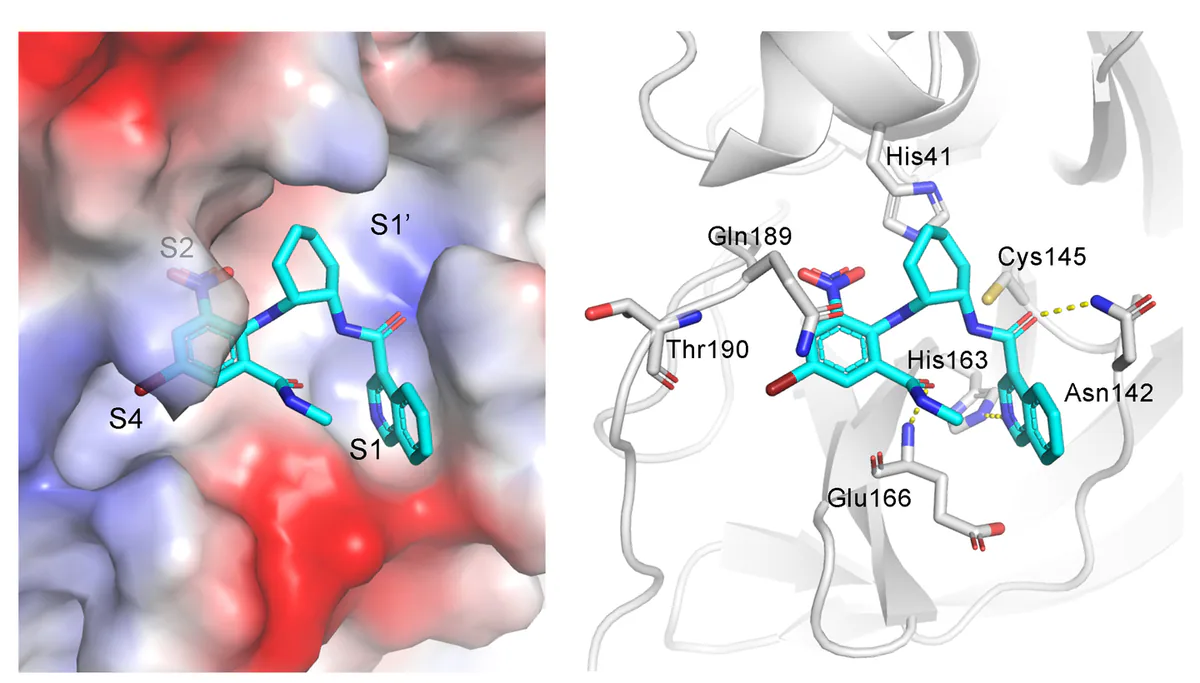
Over the following two years the team ran a complex medicinal chemistry optimisation on that molecule, feeding high-quality experimental data back into the AI model for continuous retraining, then using model predictions to guide the next round of experiments. In the end, experiments confirmed that WLU6937 was the best performer among 49 billion compounds.
“With AI we closed the loop of data integration in drug discovery: computational prediction, experimental validation, data feedback and model refinement,” Jing Huang said.
Question 3: What obstacles remain for AI-assisted drug discovery?
“AI already delivers clear cost and time savings in original drug discovery, but it has not yet transformed the whole R&D system,” Jing Huang said. At this stage, several practical obstacles remain.
For example, drug discovery is a very long chain, and AI is often applied to one specific step early on — such as optimising known compounds against known targets.
“The greater value of AI is as the core tool for integrating information and supporting decisions in early discovery: connecting structural biology, medicinal chemistry, activity and developability data from different sources, and reducing the cost of repeated trial and error,” he said.
Question 4: What does Mprosevir® teach us?
“The approval of Mprosevir® shows that genuine AI-assisted drug discovery is now efficient and feasible,” said Tingliang Wang, Assistant President of Westlake University, who led capital introduction and technology transfer for the project.
Jing Huang argues that AI-assisted discovery is no longer a concept: it can carry an original drug from discovery through clinical development to approval.
“The important lesson from this project is that high-quality data must be collected deliberately from the very start, and used continuously to retrain the AI models,” he said. Only then can AI integrate the flow of information from every R&D stage and act as a decision-support tool across a whole programme, rather than in one isolated step.