

Finding molecules that can treat a specific disease, efficiently and precisely, within the vastness of chemical space is one of the central challenges of drug discovery. DNA-encoded library (DEL) technology emerged to meet it.
DEL tags each molecule in a library of trillions with a unique identifier, letting researchers identify molecules from that enormous pool and obtain hits quickly. Its potential has made DEL one of the most closely watched early-discovery technologies of recent years.
Yet after more than two decades of development, very few molecules found through DEL have reached the clinic. In practice, hit rates vary markedly between target proteins — a pain point that has held back the technology’s value. Why that happens has long been a blind spot for the field.
Recently, Westlake Pharmaceuticals co-founders Jing Huang and Hu Qi published “Deciphering DEL pocket patterns through contrastive learning” in Nature Communications. The study is the first to ask and answer, at the level of the binding pocket, which protein pockets are better suited to DEL screening. It also introduces ErePOC (Enhanced Representation of POCkets), the first AI model purpose-built to identify DEL-compatible targets.

Paper link
https://www.nature.com/articles/s41467-026-69663-y
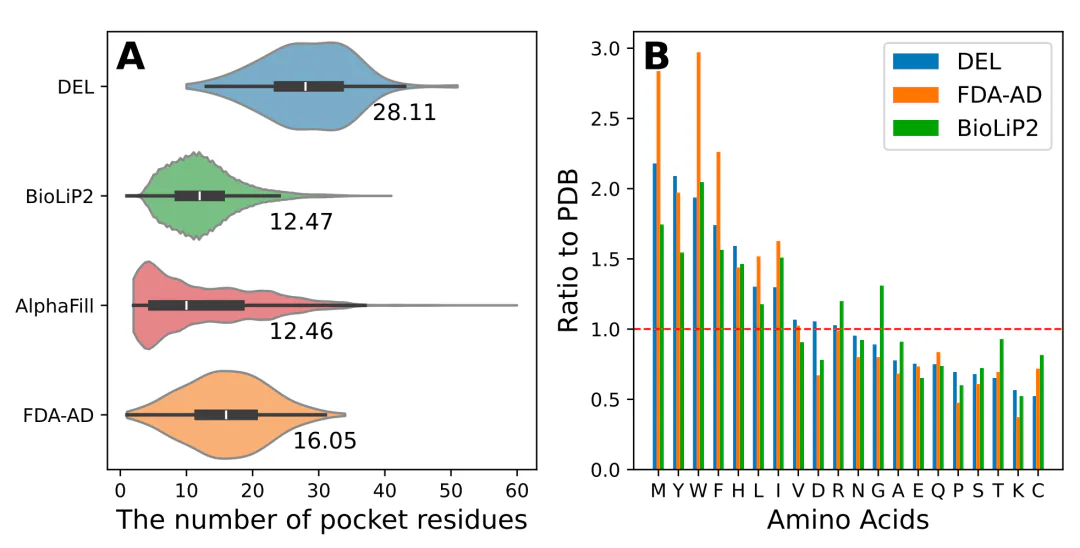
Analysing large-scale pocket structures together with DEL binding data, the Jing Huang group found that DEL-binding pockets overlap substantially with conventional druggable pockets in overall character, but differ significantly — in ways not previously recognised — in pocket volume, hydrophobicity and interaction patterns. Selecting a target for DEL is therefore not simply an extension of conventional “druggability”; it is subject to more specific structural and functional constraints at the pocket level. The study provides the first theoretical definition of target suitability for DEL screening.
Because pocket features are high-dimensional while DEL data are sparse, the Jing Huang group introduced a contrastive-learning strategy, using ligand chemical similarity as a supervisory signal to compress and align pocket representations, and built the pocket representation model ErePOC.
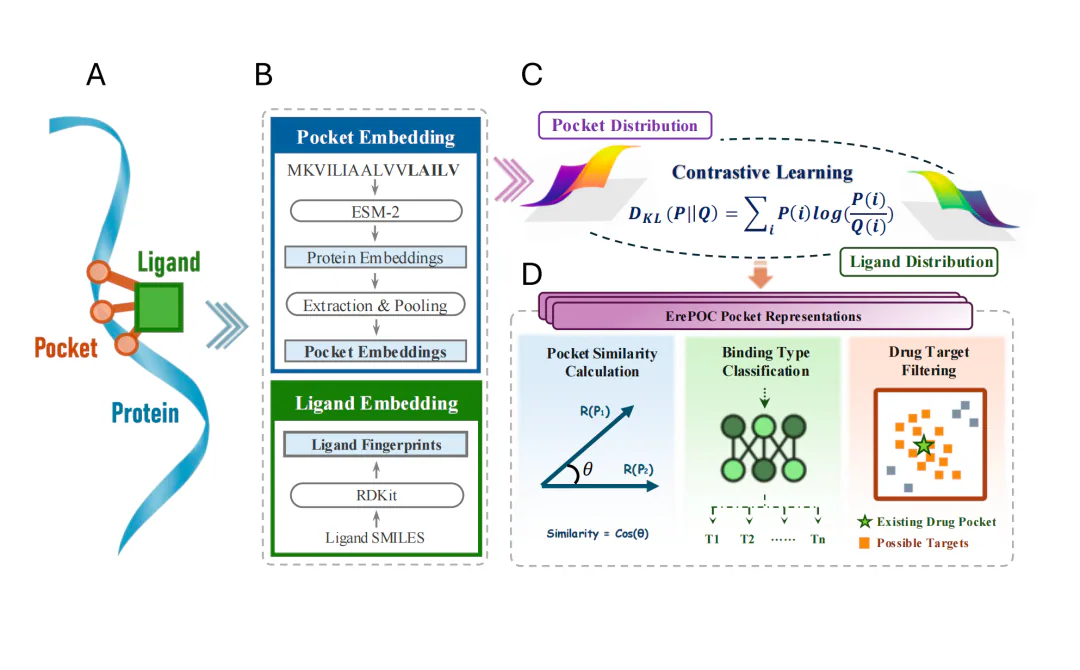
What makes ErePOC distinctive is that it aligns chemical space of ligands with the functional space of protein pockets for the first time, enabling structure-independent target identification. It can help researchers find potentially bindable targets across protein families, and can be extended to proteome-scale screening.
In the study, the group used ErePOC for several downstream tasks, validating both its discriminative power and its generalisation.
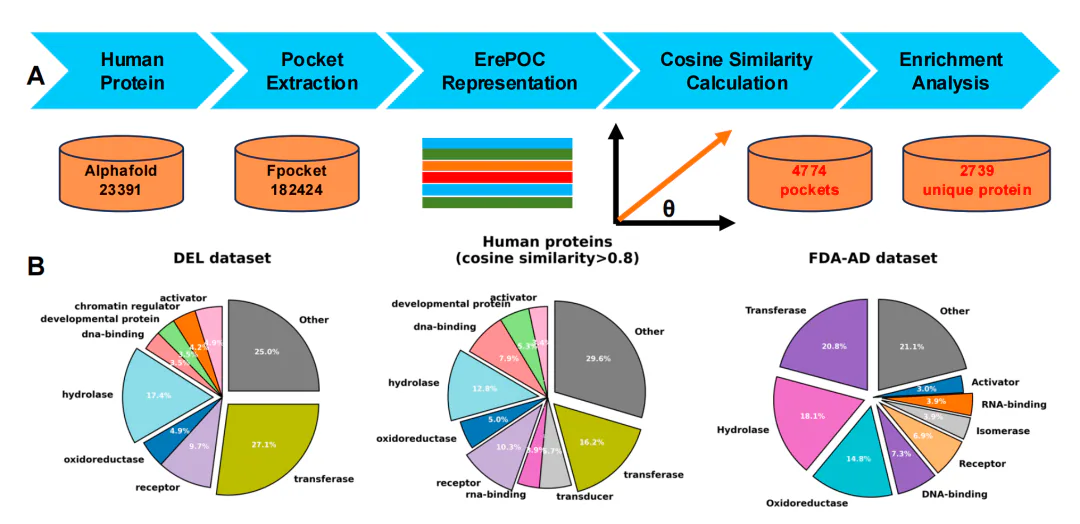
With ErePOC, researchers can choose targets better suited to DEL before screening begins, focus resources on directions with a high chance of success, and turn DEL from “high-throughput attempts” into “screening with a strategy”.
Deep integration of DEL and AI is a frontier of global drug discovery and one of the technology paths Westlake Pharmaceuticals pursues. In the company’s first pipeline the team already used transfer learning and pretrained models to solve the problem of DEL screening results being dominated by false positives, identifying hit compounds in about two months. Since then the company has kept upgrading its “DEL + AI” model, achieving further gains in efficiency.
As a technology transfer company of Westlake University and Westlake Laboratory, Westlake Pharmaceuticals roots its R&D in a deep understanding of scientific mechanism. The team knows that real industrial progress cannot stop at applying frontier technology; it requires understanding the causes behind the phenomena. This theoretical work is the foundation for the next iteration of the company’s “DEL + AI” approach.
Turning advanced technology efficiently into medicines of clinical value is the company’s enduring mission, and that goal depends on progress across the field. Westlake Pharmaceuticals hopes this work offers the industry new insight, and looks forward to working with partners on further gains in efficiency so that innovative medicines reach patients sooner.